
Why Does My Lower Back Hurt?

A calm, evidence-informed explanation of why lower back pain starts, what scan findings can mean, what you can do today and when to seek medical help.
By Matthew Mott, Senior Osteopath | Omega Health Injury & Wellness Centre CIC | Approximately 10 minutes
First things first...
If you have searched this question, there is a good chance you are in pain, worried, or simply frustrated that your back is not doing what you need it to.
Perhaps you bent down to tie your shoelaces and felt a sudden sharp pain. Maybe you woke up stiff and sore, or your back has been aching for several weeks and you are beginning to wonder why it is not improving.
Whatever brought you here, one of the first questions many people ask is: “Have I done something serious?”
It is a completely understandable concern. The reassuring news is that most episodes of lower back pain are not caused by a dangerous medical condition. Your pain can still be severe, limiting and very real, but the vast majority of people do not need surgery and can recover with time, sensible guidance and a gradual return to activity.
So before we talk about discs, muscles or joints, I would like you to know something I tell people in clinic almost every day:
There is every reason to be optimistic.

Tell me what happened...
One of the first questions I ask someone who comes into the clinic is: “Tell me what happened.”
Sometimes the answer is obvious. You lifted a heavy box, spent all weekend gardening, helped someone move house or increased your training more quickly than usual.
Just as often, people pause before saying: “Nothing really... I just woke up with it.”
That can be confusing because we naturally expect pain to have one identifiable cause. In reality, lower back pain often develops through several factors coming together over days or weeks rather than one structure suddenly failing.
As we talk, I am usually building a picture. How have you been sleeping? Has work been particularly stressful? Have you been sitting for longer than usual? Have you recently started exercising again, or done much more or less than your body has become used to?
Individually, none of these factors proves why your back hurts. Together, however, they can influence how much load your back is managing, how well you recover and how sensitive your nervous system becomes.
One thing I have noticed over the years is that people often remember the movement that triggered the pain, but the back may have been under increasing pressure long before that final movement happened.

So, what is actually happening?
This is where people often expect me to point to one structure and say: “That is exactly what is causing your pain.”
The honest answer is that, in many cases, it is not that simple.
Your lower back is made up of vertebrae, discs, joints, ligaments, muscles, nerves and connective tissue that work together. Any of these tissues can become irritated or sensitive, but pain is not determined by the tissues alone. Your nervous system also has an important role in deciding how strongly a threat is perceived and how much protection the body produces.
One of the roles of pain is to protect us. It is part of the body’s alarm system. When tissues are irritated, overloaded or perceived to be under threat, that alarm encourages us to change what we are doing while the body responds.
Like any alarm, however, it can sometimes become more sensitive than it needs to be. That does not make the pain imaginary or mean it is “all in your head”. It means that pain is a real protective experience influenced by the tissues, the nervous system and the wider circumstances around you.
This helps explain why movements that felt comfortable last week might be painful today, and why the intensity of pain does not always match the amount of tissue damage present. A paper cut can be surprisingly painful despite being small, while someone may occasionally sustain a more significant injury before feeling its full effect.
Pain is real, but pain and damage are not the same measurement.

What if I have been told I have a disc bulge?
This is one of the most common questions I hear.
MRI scans can be extremely useful when they are clinically indicated, particularly when symptoms or examination findings suggest nerve compression or another condition that could change management. However, scans also show many changes that are common in people who have no back pain at all.
A large systematic review led by Brinjikji and colleagues analysed imaging findings in 3,110 people without symptoms. At the age of 50, the estimated prevalence of disc degeneration was 80%, disc bulges 60% and disc protrusions 36%. In other words, these findings can be present in people whose backs do not hurt. [1]
This does not mean that every scan finding is irrelevant. A disc or another structure can contribute to symptoms, particularly when the scan, the pattern of pain, neurological findings and clinical examination all point in the same direction.
It does mean that a scan should not be interpreted on its wording alone. Terms such as “degeneration”, “bulge” and “wear and tear” can sound alarming, but they do not automatically tell us how much pain you should have, what you can safely do or whether you will recover.
That is why current NICE guidance advises against routine imaging in non-specialist care and recommends imaging in a specialist setting only when the result is likely to change management. [2]
We treat the person in front of us, not an MRI report in isolation.
So what should you do now?
This is usually the point in the consultation where people ask: “So... what should I do?”
The answer depends on your individual situation, but for most people the goal is not to avoid movement completely. It is to find a level of movement your back can currently tolerate and build from there.
Years ago, people with back pain were commonly advised to stay in bed until the pain settled. We now encourage most people to continue with normal activities as far as they are able. NICE guidance specifically recommends advice on self-management and encouragement to continue normal activities. [2]
That does not mean ignoring severe pain or forcing your way through every task. If a 30-minute walk leaves you substantially worse for the rest of the day, that may be too much at the moment. Equally, avoiding all movement because you are frightened of causing damage can sometimes reduce confidence, increase stiffness and make returning to normal activity harder.
Instead, we try to find the middle ground. I often describe this as working with your back rather than fighting against it.
You do not need to be completely pain-free before you move again. Some discomfort can be acceptable while your back settles, provided it feels manageable and any increase is short-lived rather than producing a major, sustained flare-up.

Five things you can do today
If you were sitting in my clinic today, these are often the first practical things we would discuss.
1. Keep moving where you can
Short walks, gentle changes of position and ordinary light activities can help you remain mobile. Movement does not need to look perfect to be useful, and a small amount repeated through the day may be more manageable than one long session.
2. Change position regularly
Backs are capable of sitting, standing, bending and lifting, but staying in any one position for a long time can become uncomfortable when the area is sensitive. There is no magic posture or fixed time limit. Aim for variety rather than trying to hold yourself perfectly.
3. Try not to interpret every twinge as harm
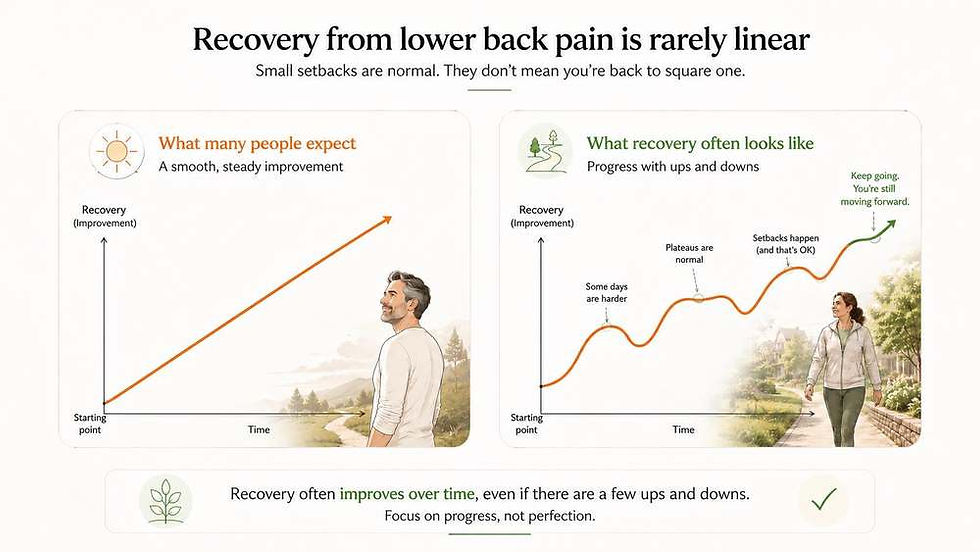
As your back begins to recover, some movements may remain uncomfortable. That does not necessarily mean you have caused fresh damage. Recovery is rarely a perfectly straight line, and a slightly worse day does not automatically put you back at the beginning.
4. Look after the bigger picture
Sleep, stress, general health, work demands and physical activity can all influence pain and recovery. Improving these areas will not instantly remove every symptom, but they can change how well your body copes and help create better conditions for recovery.
5. Give recovery some time
Many people notice meaningful improvement over the first few weeks, but the pace varies. Symptoms often change gradually rather than disappearing overnight, and recurrence is common even after a good recovery. [3]
When would I want you to seek help sooner?
Most lower back pain is not caused by a dangerous condition, but there are symptoms that change how urgently I would want you to be assessed.
Seek urgent assessment at A&E
Go to A&E urgently if you develop new bladder or bowel changes, such as difficulty starting or controlling urination or loss of bladder or bowel control; numbness around the genitals, inner thighs or buttocks; recent numbness or pins and needles in both legs; or major or rapidly worsening leg weakness. These symptoms can be associated with significant nerve compression and should not wait for a routine appointment. If you cannot travel safely or are otherwise critically unwell, call 999.
Arrange prompt medical assessment
I would also want you to seek timely medical advice if your back pain follows a major fall or accident; if you have osteoporosis and develop pain after a smaller injury; or if the pain is accompanied by fever, unexplained weight loss, a history of cancer, significant immune suppression or feeling generally unwell.
Persistent, severe night pain that is not meaningfully affected by position or movement also deserves assessment, particularly when it appears alongside any of the features above.
These symptoms do not automatically confirm a serious problem. They simply lower the threshold for an appropriate medical assessment. If you are unsure how urgently you need help in the UK, NHS 111 can advise; call 999 for an emergency.

Do you need treatment?
Not everyone with lower back pain needs treatment. Many episodes improve with time, reassurance and a sensible return to normal activity.
An assessment can be useful when the pain is stopping you from working, sleeping or managing day-to-day life; when symptoms are travelling into the leg; when you are unsure what is safe; when the problem keeps returning; or when you are not seeing the improvement you expected.
A good assessment should do more than give the pain a label. It should listen to what happened, screen for features that need medical investigation, assess movement and nerve function where appropriate, and help you build a plan that fits your goals and circumstances.
Hands-on treatment can sometimes help reduce symptoms or make movement feel easier, but it should not be presented as putting a weak or displaced back back into place. NICE recommends manual therapy only as part of a package that includes exercise, with or without a psychological approach. [2]
The aim is not to make you dependent on treatment. It is to help you understand what is happening, regain confidence and return to the activities that matter to you.
Frequently asked questions
Should I stretch my lower back if it hurts?
Gentle stretching can feel helpful for some people, particularly when the area feels stiff or guarded. There is no single stretch that is right for every back problem, and forcing a painful movement is not necessary. Choose movements that feel tolerable and leave you the same or better afterwards. If a stretch repeatedly aggravates your symptoms, try a different movement or seek individual advice.
Is walking good for lower back pain?
For many people, yes. Walking is a simple way to remain active and can be adjusted easily. Start with a duration you can manage, even if that is only a few minutes, and build gradually. A shorter walk repeated later may be more useful than pushing through one long walk that causes a significant flare-up.
Should I have an MRI scan?
Most people with uncomplicated lower back pain do not need an MRI. Imaging is more useful when the result is likely to change management, such as when symptoms or examination findings suggest significant nerve involvement or another specific condition. A clinician can help decide whether imaging is appropriate. [2]
How long does lower back pain usually last?
Many new episodes improve substantially over the first few weeks, but there is no single timetable that applies to everyone. Some recover quickly, while others have symptoms that fluctuate or recur. A flare-up does not necessarily mean your back has become progressively damaged, but persistent or worsening symptoms deserve reassessment. [3]
Can stress really make my back hurt?
Stress does not mean the pain is imagined, and it does not automatically damage the back. It can, however, affect sleep, muscle tension, recovery, attention and the sensitivity of the nervous system. For some people, addressing stress is one useful part of a wider recovery plan rather than the entire explanation for their pain. [3]

Before you leave...
If you have made it this far, I hope one thing has become clear: lower back pain is common, but that does not make it any less real.
Pain can be frightening, especially when it stops you doing the things you enjoy or makes you worry about the future. One of the hardest parts is often the uncertainty. You may not know exactly why it started, how long it will last or whether you are doing the right things to help it recover.
The good news is that, for most people, the outlook is positive. Your back is designed to move, carry load and adapt throughout your life. Even when it is painful, it is rarely as fragile as it feels.
That is why one of my main aims in clinic is not simply to reduce pain. It is to help people understand what is happening, rebuild confidence and return to the life they want to live.
Sometimes that includes hands-on treatment. Sometimes it is a specific exercise plan. Sometimes the most valuable step is understanding that movement is safe again. More often than not, it is a combination tailored to the person in front of me.
If there is one message I would like you to remember after reading this article, it is this:
Pain does not automatically mean damage, and a painful back does not automatically mean a weak back.
Understanding your pain is often the first step towards regaining confidence in your body.
Your back is strong, adaptable and designed to move.

References
1. Brinjikji W, Luetmer PH, Comstock B, et al. Systematic Literature Review of Imaging Features of Spinal Degeneration in Asymptomatic Populations. AJNR American Journal of Neuroradiology. 2015;36(4):811-816. doi:10.3174/ajnr.A4173.
2. National Institute for Health and Care Excellence. Low back pain and sciatica in over 16s: assessment and management. NICE guideline NG59.
3. Hartvigsen J, Hancock MJ, Kongsted A, et al. What low back pain is and why we need to pay attention. The Lancet. 2018;391(10137):2356-2376. doi:10.1016/S0140-6736(18)30480-X.
4. Foster NE, Anema JR, Cherkin D, et al. Prevention and treatment of low back pain: evidence, challenges, and promising directions. The Lancet. 2018;391(10137):2368-2383. doi:10.1016/S0140-6736(18)30489-6.
About the Omega Knowledge Hub
The Omega Knowledge Hub exists to make high-quality musculoskeletal healthcare information accessible to everyone. Every article is designed to help you better understand your body, make informed decisions about your health and feel more confident about your recovery.
Medical disclaimer
The information provided in the Omega Knowledge Hub is intended for general educational purposes only. It does not diagnose a condition and should not be considered a substitute for an individual assessment by a qualified healthcare professional. Every person and every condition is different. If you are experiencing severe symptoms, new neurological symptoms or are concerned about your health, seek appropriate medical advice. For an emergency in the UK, call 999 or attend A&E. While every effort is made to ensure the information is accurate, medical knowledge and clinical guidance continue to evolve.
Comments